
Early Light
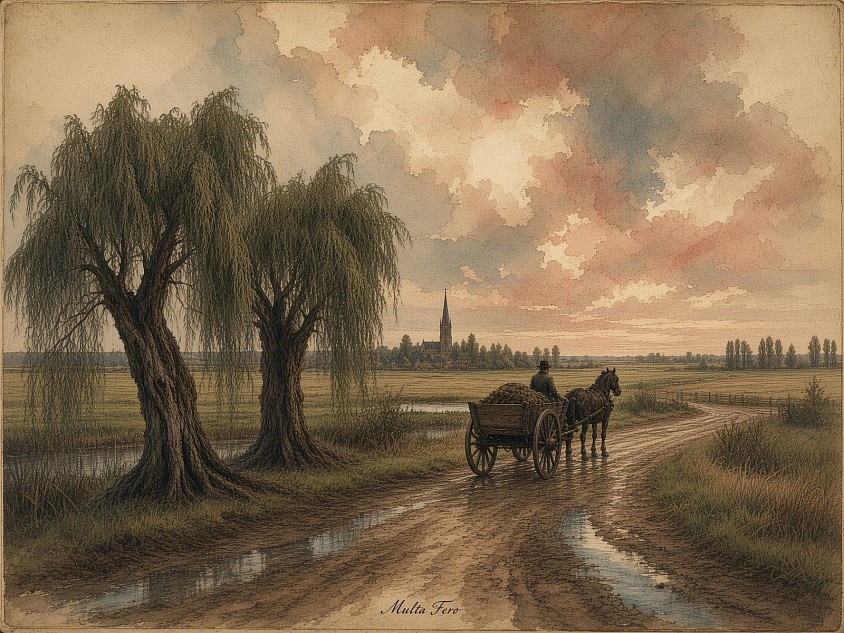
Groot-Zundert
1853-1868, Groot-Zundert
The century’s gaze settles once more upon the low roof in Groot-Zundert. Rain threads the thatch. Inside, peat smoke and damp wool thicken the air as the midwife’s reddened hands work. Anna Cornelia grips the bed; Theodorus waits beyond the door, Bible closed on his knee. Exactly one year earlier a first child, already cold and already named Vincent, had been laid beneath a simple stone. That name still hangs unfinished in the house.
A thin cry breaks the March evening. The living infant is placed in his mother’s arms. Outside, Catholic bells mark the hour; inside, Reformed quiet settles around the cradle. The same sky, the same village, the same name spoken twice—once into earth, once into breath.
The midwife studies the dark-haired child later and says, without malice, “He has the look of the other. God takes one and gives another the same name. It is a heavy thing.” Anna answers only that the name was already written. Theodorus, hearing from the study, turns the pages of his Bible and thinks: the second must answer for both. Anna, rocking the cradle, feels the same weight from the opposite shore and leaves the boy a little farther from her than the older children, as if distance might soften the inheritance.
The boy grows inside the silences of the parsonage. He trails his father across the heath, learns duty as a fence against the Catholic fields, and begins to draw—first wheel ruts filling with water, then the dark line of the hedgerow, never the house itself. At seven the name still passes between the parents like an unclaimed debt.
One evening Theodorus calls him into the study. “A name is not a garment one may cast off. Your brother bore it first. You bear it second. Do you accept the burden?” Vincent answers simply that he feels the rain and the trees; the name is there whether he looks at it or not. The father’s mouth tightens. The child carries both stone and charcoal in silence.
In October 1864 a cart takes him to Zevenbergen. Letters home speak of younger children and parish costs, never of the empty space he left. He hides drawings inside his primer. When a master discovers them and calls them idleness, Vincent answers that the heath is not behind him; it is inside the paper, keeping the water from disappearing. He writes the conjugations a hundred times and slips one small mark of a wheel rut between the lines.
Tilburg follows in 1866—colder walls, longer corridors, the same hidden stubs of charcoal. Another master confiscates the sketches of canal and mill smoke. Another night of conjugations follows, and again the boy leaves faint traces only he can read. Letters arrive measured and brief: “Remember whose name you bear.” Anna’s rarer notes mention that the early drawings have not faded. Between claim and line the second Vincent learns to breathe.
In March 1868 the cart rolls home through the same ruts. The name travels with him still. The lines travel with him still. The empty cradle remains an invisible third at every table. He unpacks the surviving sheets into the drawer once more and continues, in secret hours, the only reply that does not demand he become the one who never drew breath.
Ah reader, the great ledger of the age records wars and unifications; the smaller ledger of this Dutch family records a name given twice and a child who answers absence with charcoal. Destiny does not always announce itself with trumpets. Sometimes it begins with a midwife’s linen, a pastor’s silence, a mother’s folded hands, and a boy who keeps the water visible a moment longer. The rain continues; the Eternal Observer remains at the window of the years.
